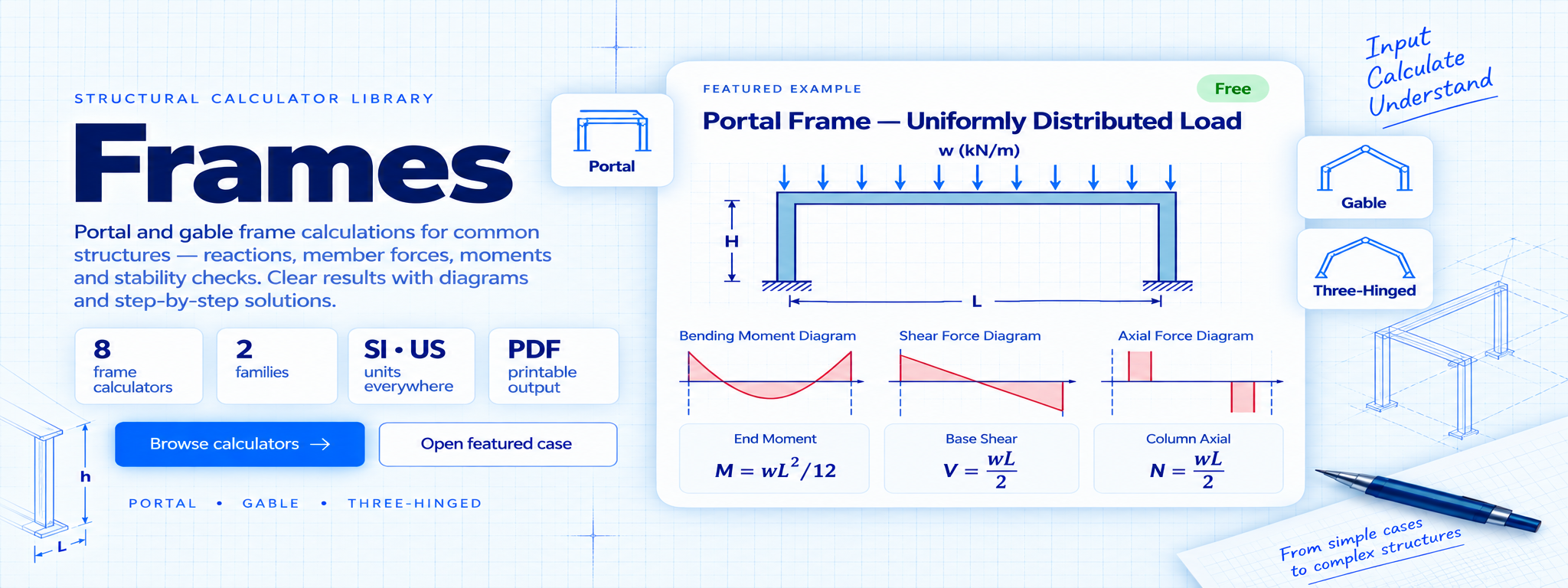
About the frame calculators
These calculators solve single-bay rectangular portal frames and symmetric gable frames, with pinned or fixed bases, under vertical load on the beam or rafters and horizontal load at the eaves. They give the support reactions, the horizontal thrust, the bending moments at the corners and in the beam, and the axial and shear forces in every member, drawn on the frame.
Why frames are different from beams
In a frame the beam and the columns are joined rigidly, so they share the bending. A vertical load on the beam pushes the column tops outward; pinned bases resist this with a horizontal thrust that produces moments at the corners and reduces the mid-span moment of the beam. How much moment goes to the corners depends on the relative stiffness of beam and columns: a stiff beam on slender columns behaves almost like a simple beam, a slender beam on stiff columns almost like a fixed-ended one.
Methods and limits
Two-hinged portals follow Kleinlogel's rigid-frame formulas and the unit-load (force) method; fixed-base frames use slope-deflection; the three-hinged gable frame is solved by equilibrium alone. The results are first-order and elastic: second-order (P-Δ) effects, column buckling, joint flexibility and base fixity in real foundations must be checked separately.
The free pinned-base portal frame calculator shows the whole method with the steps written out.