About the beam calculators
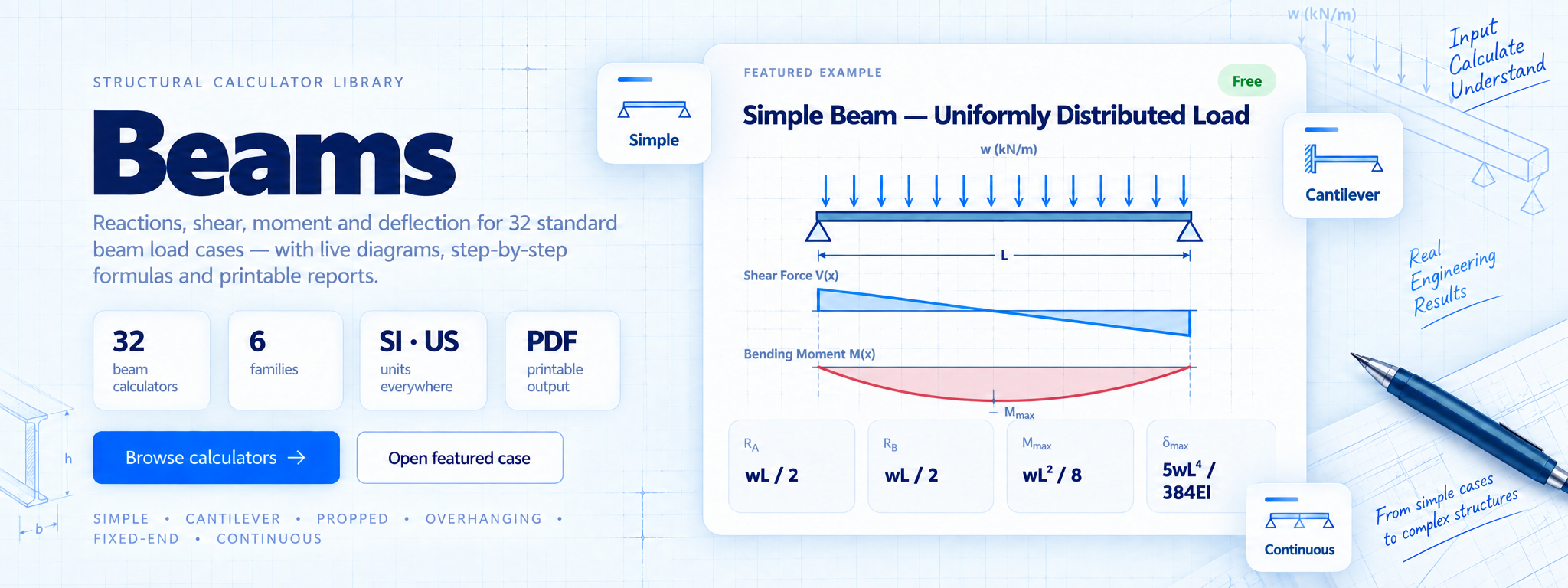
The library covers the 32 classic load cases of AWC Design Aid No. 6: simply supported beams under uniform, partial, triangular and concentrated loads; cantilevers; beams fixed at one end and supported at the other; beams fixed at both ends; beams overhanging one support; and two-span continuous beams. Each calculator gives the reactions, the shear and moment diagrams, the deflected shape and the values at any point along the span.
Choosing the right case
Start from the supports. A beam resting on walls or connected with simple shear connections is usually treated as simply supported; a beam cast into a stiff wall or welded to a much stiffer member may be closer to fixed. When the restraint is uncertain, bracket the answer with two cases: the simple beam gives the largest span moment and the fixed beam the largest support moment. The guide Simple, propped, fixed or continuous compares the cases side by side.
What the results assume
The formulas assume a straight, prismatic, linear-elastic beam with small deflections; the material enters only through the stiffness EI, so the same tools serve steel, timber and uncracked concrete. Shear deformation, lateral-torsional buckling and local effects at supports are not included. Loads are entered as working values — apply the load factors of your design code before comparing moments with resistances.
New to the topic? Read how to draw shear and moment diagrams and how to check deflection limits, then try the free simple beam calculator.