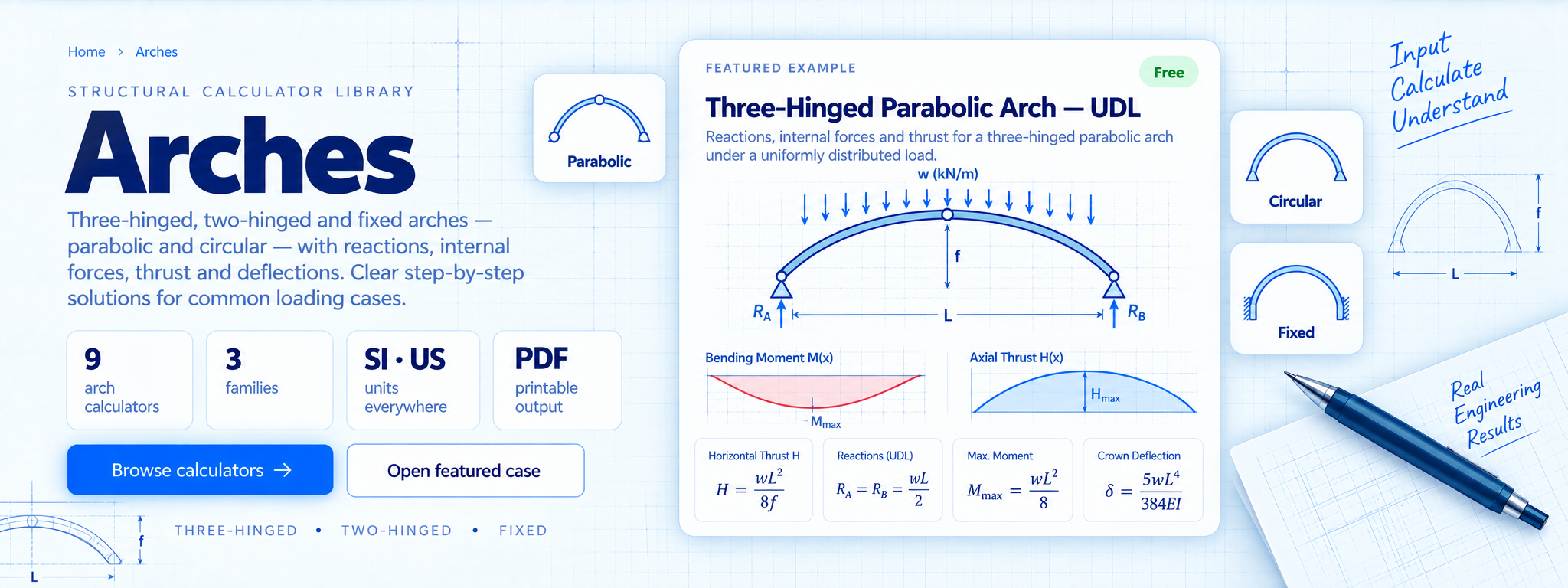
About the arch calculators
The arch library covers three-hinged parabolic and circular arches, two-hinged parabolic and circular arches, and fixed parabolic arches, under full-span uniform load, half-span load and concentrated loads. Each calculator gives the vertical reactions, the horizontal thrust, and the bending moment and axial force along the arch, together with the arch geometry.
Thrust is the key quantity
An arch carries load by pushing outward on its supports. Under a uniform load the thrust is H = wL2/8f, so halving the rise doubles it — and the abutments, foundations or tie must take that force. A parabolic arch under a load uniform along the span is in pure compression; half-span and concentrated loads add bending, which is why the unbalanced cases often govern the section.
Which type to choose
Three-hinged arches are statically determinate: settlement and temperature cause no internal forces, which suits timber and steel halls. Two-hinged arches are stiffer under unbalanced load but react to temperature and support spreading. Fixed arches are the stiffest and the most sensitive to foundation movement. The guide Three-hinged, two-hinged and fixed arches explains the differences with a worked example.
The calculators are first-order and elastic; in-plane and out-of-plane buckling of slender arches must be checked separately. Start with the free three-hinged parabolic arch calculator.